2025

Book Review- Mehra, Kushal. Nastik: Why I Am Not an Atheist. BluOne Ink. 2024

In the present globalized age, where almost every sphere of society is being aided by Artificial Intelligence (AI), religion has little impact among individuals. The world has started to shift from the traditional belief of a ‘Supreme Being’ to relying more on machines and AI. This has further led to individuality, a concept which places […]

Book Review- Mehra, Kushal. Nastik: Why I Am Not an Atheist. BluOne Ink. 2024 Read More »

Book Review- Bharadwaj, Sudha. From Phansi Yard: My Year With The Women Of Yerawada. Juggernaut Publication. 2023.

In Indian society, prisons are a taboo. They are spaces that evoke curiosity, disgust and fear. Whoever enters a prison, whether convicted or not, carries the social stain of incarceration for life. Society perceives it as a place that needs to be kept segregated, people that need to be punished and locked up. Hence, what

Book Review- Bharadwaj, Sudha. From Phansi Yard: My Year With The Women Of Yerawada. Juggernaut Publication. 2023. Read More »

Poverty’s Persistent Grip – A Struggle For Global Justice

Abstract Global poverty eradication is a fundamental international obligation and through this research paper, I intend to explore the multifaceted impact of poverty on the issue of global justice. I start by examining the ways in which poverty undermines access to justice, exacerbates inequality, and contributes to social instability and corruption. Thereafter, the paper tends

Poverty’s Persistent Grip – A Struggle For Global Justice Read More »

Populism and Constitutionalism: Analyzing Judicial Appointment Reforms in India and Israel

Abstract This article explores the intersection of constitutionalism and populism through a comparative analysis of judicial independence in India, and Israel. By examining the judicial reforms in these nations, it highlights the tensions between populist governments and the judiciary, a key institution in liberal democracies. The study underscores how populist leaders, driven by majoritarian mandates,

Populism and Constitutionalism: Analyzing Judicial Appointment Reforms in India and Israel Read More »

Old Sword In New Sheath: An Analysis Of Section 152 Of Bharatiya Nyaya Sanhita Abstract

Abstract The new sedition law, Section 152 of the Bharatiya Nyaya Sanhita (BNS), ostensibly enacted to rid Indian criminal law of colonial vestiges, has merely perpetuated and expanded the sedition framework of its predecessor, Section 124A of the Indian Penal Code (IPC). The imprecise and sweeping language of Section 152 BNS not only retains the

Old Sword In New Sheath: An Analysis Of Section 152 Of Bharatiya Nyaya Sanhita Abstract Read More »

Pluralistic Heritage Governance In Maharashtra: A Case Of Raigad Fort Conservation

Abstract This paper investigates how the state of Maharashtra fulfils its constitutional mandate for heritage conservation within a pluralistic legal and institutional framework. While the central government governs only the national monuments, Indian states like Maharashtra oversee a complex and often fragmented heritage landscape that includes state-protected monuments, World Heritage Sites, urban heritage, and vernacular

Pluralistic Heritage Governance In Maharashtra: A Case Of Raigad Fort Conservation Read More »

Rethinking Minority ‘Establishment’ Post-Naresh Agarwal Judgment

Introduction For over fifty years, the question of whether Aligarh Muslim University (AMU) qualifies as a minority institution under Article 30(1) of the Indian Constitution has sparked legal controversy, constitutional debate, and no small amount of political heat. At the centre of this long-running debate lies a 1967 Supreme Court decision of S. Azeez Basha

Rethinking Minority ‘Establishment’ Post-Naresh Agarwal Judgment Read More »

A Critical Analysis of The Command Responsibility In Théoneste Bagosora’s Case At The ICTR- From Ethnic Polarisation to Systematic Violence

Introduction   The prosecution of Colonel Théoneste Bagosora by the International Criminal Tribunal for Rwanda (ICTR) marks a significant chapter in the quest for justice against high-ranking military figures involved in the 1994 Rwandan genocide. Serving as the director of cabinet for Rwanda’s Ministry of Defence, Bagosora was found guilty of genocide, crimes against humanity, and war crimes based on the principle

A Critical Analysis of The Command Responsibility In Théoneste Bagosora’s Case At The ICTR- From Ethnic Polarisation to Systematic Violence Read More »

CONFRONTING CONSCIENCE: THE ROLE OF LITERARY NARRATIVES IN SHAPING LEGAL MINDS 

Abstract: The proverbial debate over the influence of ethical conundrums and their reflection on the lives of impressionable youth is at its precipice. The contemporary law student – more so than students in any other discipline – isdelving into the question, “Whether the moral exhortations and ethical dilemmas, averring an existential crisis that haunts the protagonist of a literary work,give

CONFRONTING CONSCIENCE: THE ROLE OF LITERARY NARRATIVES IN SHAPING LEGAL MINDS  Read More »

ALGORITHMIC INJUSTICE: AI, CASTE, AND DEMOCRACY IN INDIA

 Abstract India’s judiciary, with a backlog of 48 million cases, has taken recourse to artificial intelligence (AI) to become more efficient. This change, however, is fraught with danger. AI systems being trained on colonial period legal precedents and skewed data are perpetuating old injustices and stifling dissent. Systems such as Trinetra, a predictive policing platform,

ALGORITHMIC INJUSTICE: AI, CASTE, AND DEMOCRACY IN INDIA Read More »

Balancing Justice: The Complex Interplay Between Public Opinion And Judicial Independence

In countries like India and the U.S.A., independence of Judiciary lays down the foundation of democracy. One of the four minimum requirements for securing independence of Judiciary is the immunity of judges from civil accountability. At the same time, it is also true that Judiciary needs to gain legitimacy through public support. The courts have

Balancing Justice: The Complex Interplay Between Public Opinion And Judicial Independence Read More »

Re-Evaluating the Corporate Veil in Environmental Catastrophes

Abstract The corporate veil is an anchor of corporate law and normally protects shareholders and directors from liability. In environmental catastrophes, this shield shields the wrongdoer and prevents justice from being served to the victim. This paper critiques the Indian fault-based liability framework that exhibits gaps such as weak enforcement, procedural delays, and inadequate deterrence.

Re-Evaluating the Corporate Veil in Environmental Catastrophes Read More »

‘A Paradoxical Majority ?’: Making A Case For Affirmative Actions in Parliament For Young

A few heart whole, sincere and energetic men and women can do more in a year than a mob in a century. – Swami Vivekananda Introduction The rising median age of parliamentarians is a pressing concern globally, Especially in India, Ironically, Majority of the country’s population being below the age of 35 years (hereinafter referred

‘A Paradoxical Majority ?’: Making A Case For Affirmative Actions in Parliament For Young Read More »

Resolving The Tussle Between ONPs And Big Techs Via Ex- Ante Regulations: Debarking A Madhyam Marg

1. INTRODUCTION  In the past decade, the digital economy in India has seen a rapid growth bolstered by the ready accessibility of smartphones and internet connectivity. This digital growth has reached a stage attracting both benefits and concerns related to monopolistic practices and a lack of transparency.  Big techs like Google, Apple, Facebook and Amazon (GAFA)  have started to

Resolving The Tussle Between ONPs And Big Techs Via Ex- Ante Regulations: Debarking A Madhyam Marg Read More »

Fixing Family Feuds: Evaluating Mediation In Matrimonial Disputes In India

Introduction “An ounce of mediation is worth a pound of arbitration and a ton of litigation.”[1] The statement metaphorically yet beautifully captures the essence of mediation as an efficient method of dispute resolution. The Indian courts have acknowledged the need for mediation within the justice system, thereby ushering in a dispute resolution mechanism that is

Fixing Family Feuds: Evaluating Mediation In Matrimonial Disputes In India Read More »

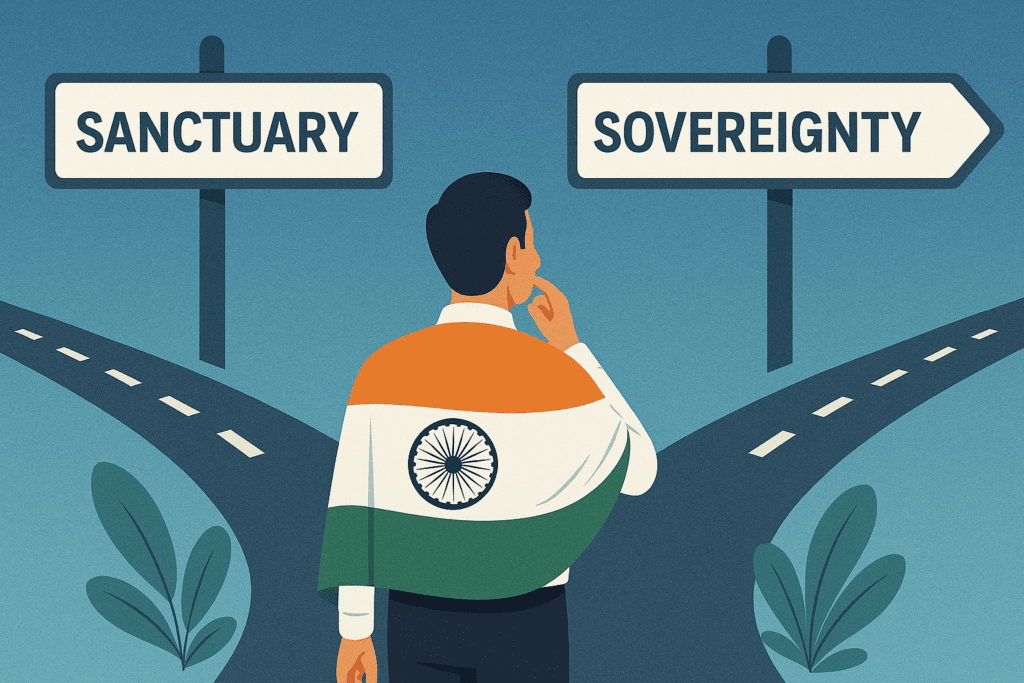
Sanctuary or Sovereignty? Analysing India’s Stance on Non-Refoulement

The blog discusses the widely recognised international principle of non-refoulement and how India has escaped its customary law status. The discussion delves into India’s legal stance, elucidating why the country remains unbound by the principle of non-refoulement, despite its global acceptance. The blog uncovers the legal justifications India employs to avoid obligations under international law, enabling the state to engage in practices that contradict the principle’s essence.

Sanctuary or Sovereignty? Analysing India’s Stance on Non-Refoulement Read More »

Promoting Sustainability in Indian Textile Industry: A Legal Perspective

The textile industry in India is a force to be reckoned with globally, but it has some major environmental challenges like water pollution. Textile production requires sustainability, focusing on water recycling, cleaner industrial processes, and improved labour standards to avoid negative consequences. In order to enhance the avenues for industries to shift towards sustainability, it is important that the municipal laws align with the international frameworks, especially in its application. Government backing and CSR investments are indispensable to encourage the adoption of eco-friendly practices. The sustainability of the textile sector will not be possible without cooperation among stakeholders.

Promoting Sustainability in Indian Textile Industry: A Legal Perspective Read More »

Diplomatic Dilemma: The Legal Battle Between South Africa And Israel

1.     INTRODUCTION One of the primary purposes of law, and international law is the resolution of disputes. International disputes are an inevitable aspect of international relations since their primary causes are deeply ingrained in the international community and the decentralised system of international law. Article 2(3) of the United Nations Charter unequivocally mandates the peaceful

Diplomatic Dilemma: The Legal Battle Between South Africa And Israel Read More »

Biometrics: Compromising Privacy For Convenience?

Biometric technology has become ubiquitous in our world, from fingerprint sensors that unlock our smartphones to facial recognition in Facebook photos. While biometrics may offer increased security and convenience, they also expose us to potential abuse, data theft, and surveillance. Consequently, governments implementing biometric national IDs and tracking systems must be cognizant of the potential harms. This article discusses the prevalent use of biometrics, its potential harms, and the way forward. As we look to the future of biometrics, it is imperative that we reassess its social consequences and explore alternative identity verification methods that respect our rights.

Biometrics: Compromising Privacy For Convenience? Read More »

Scroll to Top